Matching Perennials, Shrubs, and Trees to Kansas Hardiness Zones
Kansas gardeners often choose a plant because its label lists a suitable hardiness zone, only to find that the yard’s wind, soil, or drainage tells a different story. The zone map is a useful starting point, not a complete planting plan. Here’s how to use it to compare perennials, shrubs, and trees, then account for the conditions that shape whether they thrive.
What a Kansas hardiness zone tells you
The USDA 2023 Plant Hardiness Zone Map is the standard by which gardeners and growers can determine which perennial plants are most likely to thrive at a location, according to the United States Department of Agriculture. Its main job is to help you judge whether a plant is likely to tolerate the coldest winter conditions associated with a location.
That makes a hardiness zone useful when comparing plants that remain in the ground year after year. A perennial flower, shrub, or tree cannot be moved indoors when winter turns severe, so its ability to withstand local winter cold matters. If a plant is not cold-hardy enough for the area, it may be damaged or killed in a harsh winter, even if it grew well during a mild one.
A zone is not a promise that a plant will flourish. It does not tell you whether the plant will tolerate a dry, exposed site, heavy soil, standing water, summer heat, or insufficient sunlight. Nor does a zone guarantee that a plant will survive every winter. It describes a climate factor that helps narrow the options; the rest of the site and the plant’s needs still matter.
Think of the zone as an initial screening tool:
- Use it to assess winter cold tolerance. A plant listed as suitable for your area is a reasonable candidate for further consideration.
- Use it to compare plant choices. If two plants suit the same garden conditions but one is poorly matched to local winter cold, the hardiness information can help you rule it out.
- Do not use it as a complete care profile. Light, moisture, soil, exposure, plant health, and establishment all affect performance.
- Do not confuse it with a frost calendar. A hardiness zone does not tell you when the last spring frost or first fall frost will occur.
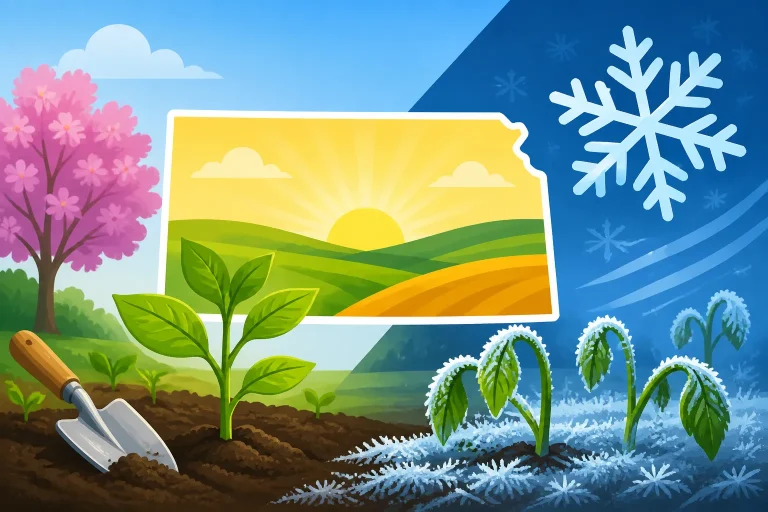
The distinction between winter hardiness and frost timing is especially important for gardeners planning around seasonal change. A perennial may be cold-hardy once established and still be vulnerable to a late spring freeze when new growth or flowers are exposed. For the separate question of frost risk, see Why Kansas Has No Single Statewide Frost Date and Kansas Seasonal Gardening Calendar: Spring Thaw to Fall Frost.
Find the right map information for your location
Kansas does not have one set of garden conditions. A plant’s prospects can differ between regions and between sites within the same community. Start by identifying the zone shown for the location where the plant will grow, then use that information alongside a close look at the garden itself.
A ZIP code can help you locate an area on the map, but do not treat it as an exact description of every yard within that area. A ZIP code covers more ground than a single garden, and a home’s location and exposure can differ from the conditions represented by a nearby map point. Use the map to narrow your choices, then check the plant’s hardiness information and local growing advice before committing to a large planting.
For a step-by-step approach to reading the map, see Finding Your Kansas Plant Hardiness Zone by ZIP Code. If your garden sits near a regional transition or seems to behave differently from nearby gardens, Planning Garden Calendars by Local Kansas Hardiness Zone Shifts can help you think through local variation without treating a map boundary as a sharp line across the landscape.
When checking a plant label or catalog, look for the hardiness information and compare it with the map location you have identified. If the label lists a range, the useful question is whether your location falls within that range and whether the plant’s other needs fit the site. If the listing is vague, incomplete, or does not state hardiness, seek a reliable local plant reference before buying several plants.
Check the exact planting site, not just the map
A map is regional. A garden is a particular place, with its own combination of sun, wind, nearby structures, slopes, and soil. Those details can affect how exposed a plant is to winter cold and how quickly it becomes established.
Notice whether the planting site is open to prevailing winds or sheltered by a building, fence, or established planting. Wind can dry foliage and soil, and exposed sites can be harder on evergreen plants and young woody plants. A sheltered corner may be less exposed, but it can also have other drawbacks, such as limited sunlight or poor air movement. Treat shelter as one feature to assess, not as a substitute for checking a plant’s needs.
Also look for changes in elevation and drainage. Low ground may stay wet after rain or snowmelt, while a slope may dry more quickly. A plant that tolerates winter cold may still struggle if its roots remain in saturated soil. Before planting a tree or shrub, note where water collects and whether the soil drains in a way that suits the plant.
Buildings, pavement, and reflected heat can create conditions that differ from an open garden bed. A location next to a wall may be warmer or drier than an exposed yard, but it may also receive concentrated runoff or have restricted root space. Observe the spot through changing weather rather than assuming that one nearby feature makes it suitable.
Match perennials to both winter cold and growing conditions
Perennials return from year to year, but their top growth, roots, and buds do not all respond to winter in the same way. Use hardiness information to screen candidates, then compare each plant’s light, soil, and moisture needs with the conditions where you want to put it.
Start with the plant’s expected growing environment. A sun-loving perennial is not a good choice for a deeply shaded bed simply because it can tolerate local winter temperatures. Likewise, a plant that prefers consistently moist soil may disappoint in a dry, exposed bed unless you can provide suitable growing conditions. Before buying, find out whether the plant needs full sun, partial shade, or shade, and whether it prefers soil that drains freely, stays evenly moist, or tolerates occasional dryness.
Then consider what winter does to the planting site. Does the bed stay exposed to cold wind? Is it near a walkway where snow or ice may accumulate? Does it drain well when the ground thaws? These questions can help explain why a plant performs differently in one bed than in another. A label that indicates suitable hardiness does not cancel out the effect of persistent wet soil or a difficult exposure.
A few familiar perennial types can help illustrate the trade-offs. Coneflowers and prairie grasses may be considered for sunny beds, while woodland flowers are usually associated with shadier sites. These broad descriptions are not a substitute for checking the needs of a particular plant. Even within a general plant group, species differ in preferred moisture, soil, mature size, and tolerance of exposure.
Consider the garden’s purpose, too. A plant chosen for flowers may need a different amount of sun than one chosen for ground cover or foliage. A dense perennial border may require plants with similar water needs so that one part of the bed is not kept too wet for its neighbors. If you are mixing plants, group them by their growing preferences as well as their ability to tolerate winter conditions.
For Kansas-specific perennial choices and local conditions, see Selecting Perennial Flowers Under Updated Kansas Hardiness Zones and Matching Native Kansas Plants to Yard Sun and Moisture. If you are planning a more naturalistic planting, Kansas Native Landscape Guide: Prairie Flowers and Resilient Trees can help you consider the broader fit between plant choices and the site.
Pay attention to establishment
A plant that is hardy once established may be more vulnerable while it is getting settled. Young plants have had less time to develop a strong root system, and recent transplants can be stressed by dry soil, excessive moisture, or abrupt weather changes. Choose a planting location that meets the plant’s long-term needs and give new plants appropriate care as they establish.
Avoid assuming that a plant’s first healthy season proves it is well matched to the site. Winter injury may appear later, and some plants can take time to show whether the location suits them. Keep notes on the planting spot, winter conditions, and any recurring symptoms. If several plants fail in the same area, examine the site’s drainage, exposure, and soil before replacing them with more of the same.
Choose shrubs and trees with long-term site conditions in mind
Shrubs and trees are larger, longer-lived choices than most garden perennials. Replacing a plant after it outgrows its space or repeatedly suffers winter damage can be costly in effort, even when the plant itself was inexpensive. Use the hardiness map as an early filter, then evaluate the mature plant and the yard before planting.
For a woody plant, check more than winter tolerance:
- Mature size: Allow room for the plant’s expected height and spread. Consider nearby walks, buildings, overhead space, and other plants.
- Sun exposure: Make sure the site offers the light the plant needs as it matures. A small tree may receive plenty of sun while young, then become shaded by a building or larger tree.
- Soil and drainage: Match the plant to the soil it will actually grow in. A hardy shrub can still struggle in soil that stays too wet or dries too quickly.
- Wind exposure: Consider whether branches, foliage, or evergreen leaves will be exposed to strong drying winds.
- Water needs: Think about whether the plant can get the moisture it needs after establishment without constant attention or conflict with other plantings.
- Maintenance and use: Decide whether you need shade, screening, flowers, wildlife value, or a defined landscape feature, and whether the plant’s growth habit suits that purpose.
For example, an eastern redbud might be considered for spring flowers, a bur oak for a larger shade-tree role, or a serviceberry for a smaller tree or large shrub form. These are possibilities to research, not universal recommendations for every Kansas yard. Check the specific plant’s hardiness, mature size, light requirements, and soil preferences, then compare them with the planting site. Do not select a tree solely because it is familiar or commonly planted nearby.
A shrub hedge also needs room to reach its intended size. Planting shrubs too close together can create crowding, limit airflow, and make future maintenance harder. A row of plants may need different spacing from a single specimen, and the best spacing depends on the mature size and form of the selected plant. For more help comparing shrubs to yard conditions, see Matching Shrubs to Local Kansas County Yard Conditions.
Trees bring additional practical concerns. Their roots need space, and their canopy will change the amount of light reaching nearby beds as it grows. A location that works for sun-loving perennials today may become shaded later. Consider how the tree will affect the rest of the landscape, not only whether it can tolerate local winters. Selecting Trees for Kansas Soil and Prairie Winds offers more detail on fitting trees to Kansas sites.
Avoid making a large planting from one successful example
A neighbor’s healthy tree or a row of thriving shrubs can be a helpful clue, but it is not proof that the same plant will suit your yard. The example may be growing in a different soil, a more sheltered location, or a different watering routine. It may also be a different species or cultivar than the one you are considering.
If you are uncertain about a plant’s fit, start with a limited planting rather than repeating it across the property. Watch how it responds to the site through a full seasonal cycle, including winter and spring growth. This is particularly useful for plants that are expensive, difficult to move, or intended to form a major landscape feature.
Use the zone alongside soil, moisture, wind, and sun
Hardiness is only one part of plant selection. A useful way to narrow choices is to compare the plant’s needs with the conditions you can observe or manage in the yard. This avoids a common mistake: choosing a plant that is suitable for winter temperatures but poorly suited to the soil or exposure.
| Site factor | What to check | How it affects plant choice |
|---|---|---|
| Winter exposure | Whether the site is open to wind or sheltered by nearby features | Exposed locations can be more stressful, particularly for young or evergreen plants |
| Sunlight | How much direct light the planting area receives and whether nearby plants will create shade | A plant’s light needs must match the site, now and as trees mature |
| Drainage | Whether water drains away or remains in the area after rain or snowmelt | Persistent wetness can harm plants that need well-drained soil |
| Soil moisture | Whether the site dries quickly or remains moist | Choose plants whose moisture preferences suit the bed or your watering capacity |
| Soil texture | Whether the soil is dense, loose, or difficult to work | Soil conditions can influence root growth, drainage, and establishment |
| Space | The room available for the plant at maturity | A plant that outgrows its space may need repeated pruning or replacement |
| Intended use | Whether the plant is meant for shade, screening, flowers, or another purpose | The plant’s eventual form and maintenance should fit the landscape plan |
Use the table as a site-checking tool, not as a ranking of which conditions matter most. A plant may tolerate a range of conditions, but the combination of needs still has to make sense. If a shrub requires well-drained soil and the proposed location stays wet, correcting the site or choosing a different plant is more sensible than relying on its hardiness rating alone.
Soil is worth particular attention. Dense or compacted soil may drain slowly, while a raised or sloped area may dry faster. Before planting a tree or shrub, observe how water behaves in the spot and check whether the soil’s texture and drainage are compatible with the plant. For help assessing soil and drainage, see Guide to Testing Kansas Garden and Lawn Soils and Testing Garden Soil Drainage Rates Before Siting Ornamental Trees.
Moisture needs should be considered alongside the realistic amount of care you can provide. A plant that needs consistently moist conditions may be a poor match for an exposed bed that dries quickly, especially if reliable watering is not practical. A plant adapted to drier conditions may also struggle in a low spot that stays wet. Choosing plants with compatible moisture needs can make a mixed bed easier to manage.
Wind can affect both the plant and the soil around it. An exposed garden may dry more quickly, and a young tree may face more stress than one planted in a sheltered location. A windbreak can change exposure, but it can also create shade or compete for water, so assess the full planting area. Garden Windbreaks for Protecting Kansas Vegetable Beds discusses windbreak considerations in a garden setting that can also help you think about exposure in a landscape.
Sunlight changes over time. A new tree may begin in full sun and later shade a nearby bed; a shrub planted under young trees may receive more light at first than it will after the canopy fills in. When planning, consider not only the present view of the sky but also the mature size and placement of nearby plants.
Build a practical selection and planting plan
A short, repeatable process can help you move from a map lookup to a confident plant choice. The goal is not to make every condition predictable. It is to rule out obvious mismatches before you buy and plant.
- Locate the planting area on the hardiness map. Use the map to identify the area associated with your location. Treat that as a regional guide rather than a precise description of every bed on the property.
- Check the plant’s hardiness information. Compare the plant listing with the area you identified. If the listing is incomplete or unclear, verify it with a reliable local reference before purchasing.
- Write down the site conditions. Note sun, wind exposure, drainage, soil texture, and how quickly the area dries. Do this for the actual planting spot, not only the garden as a whole.
- Compare the plant’s needs with the site. A good candidate should suit both the local winter conditions and the everyday growing conditions available in that location.
- Check mature size and purpose. Make sure the plant will fit the space and serve the intended role without blocking a path, competing with nearby plants, or requiring constant correction.
- Plan for establishment. Consider how you will care for a new planting as its roots develop. Do not assume that a mature plant’s hardiness means a fresh transplant needs no attention.
- Keep records and reassess. Note what was planted, where it was planted, and how it performed after winter and through the growing season. If problems repeat, reconsider the site match before replacing the plant.
This process also helps when choosing between several candidates. If all of them appear suitable for winter cold, compare their light and moisture needs next. Then consider mature size and maintenance. A plant that is a strong match for the space may be a better choice than one that merely appears to tolerate the local zone.
Separate hardiness decisions from planting-date decisions
The zone map is about whether perennial plants are likely to tolerate winter conditions; it is not a calendar for planting, pruning, or managing spring frost. Gardeners may use different seasonal information when deciding when to plant a particular perennial or woody plant. The right timing can depend on regional weather, the plant’s condition, and the task involved.
Avoid using an average frost date as a guarantee that cold weather has ended. Frost dates describe probabilities, not fixed dates, and conditions vary from year to year. If your question is when to start or move seasonal crops rather than whether a perennial is winter-hardy, consult a relevant calendar such as Kansas Planting Calendar: Spring Frost and Freeze Risks or Regional Planting Differences Across Kansas Counties.
The same distinction applies to trees and shrubs. A plant may be hardy in a location but still be affected by a late freeze when buds or flowers have started growing. Spring damage to flowers can also affect fruit production on plants grown for fruit. The hardiness zone helps screen for winter survival; it does not predict the condition of buds during a particular spring.
Avoid common hardiness-zone mistakes
A zone-based choice can still fail when gardeners ask the map to answer questions it was not designed to answer. These mistakes are avoidable once you treat hardiness as one part of a larger site assessment.
Treating a zone as a guarantee
A plant’s hardiness rating does not mean it will thrive in every yard in the mapped area or withstand every unusual winter. It indicates suitability based on winter cold, not immunity to stress. Look for signs that the plant is struggling, and consider whether the problem is related to exposure, moisture, soil, or establishment.
Treating the whole ZIP code as one garden
A ZIP code is useful for finding an approximate map location, but it should not replace observation of the planting site. A low, wet corner and a windy, exposed slope can create different growing conditions even within one yard. Use the map as the first step, then make the plant decision at the bed or planting spot.
Assuming plants that share a zone have the same needs
Two plants may both be suitable for the same hardiness area while requiring different light, soil, and moisture conditions. A plant’s zone rating does not tell you that it will pair well with another plant in a particular bed. Compare care requirements before grouping plants together.
Selecting a tree for its young size
Small nursery plants can look easy to fit into a tight space. Their mature height, spread, and root needs are more important for long-term placement. Check the expected mature form before planting, especially near buildings, walks, overhead obstacles, and other trees.
Ignoring water after establishment
A plant may be adapted to local winter conditions and still need careful attention while establishing. New roots are not the same as a mature root system. Conversely, a plant that receives too much water in a poorly drained spot can struggle even if the area is suitable by hardiness. Match care to the plant and the site rather than applying one routine to everything.
Using hardiness to predict flowering or fruiting
Winter survival does not promise reliable flowering or fruit production. A plant can survive winter but have buds or blossoms damaged during spring cold. Conditions during the growing season, pollination, plant health, and variety can also affect performance. Keep the hardiness question separate from questions about bloom, fruit set, and harvest.
For more on seasonal temperature swings and their effect on outdoor growing, see Planning Around Kansas Freeze Windows and Seasonal Temperature Swings. If you are selecting a broader mix of plants for a landscape, Annuals and Perennials Adapted to the Kansas Prairie Climate can help place perennial choices within a larger planting plan.
Frequently Asked Questions
Does a Kansas hardiness zone tell me whether a plant will thrive?
It helps you judge whether a perennial plant is likely to tolerate winter conditions at a location. It does not account for every factor that affects growth, such as soil drainage, sunlight, wind, and moisture. Check those conditions before planting.
Can I use a ZIP code to choose plants?
A ZIP code can help you locate an area on the map, but it does not describe every garden within that area. Use the map as a starting point, then assess the specific site where the plant will grow.
Are shrubs and trees covered by hardiness information?
Hardiness information can help screen perennial plants, including shrubs and trees, for winter suitability. For woody plants, also check mature size, light needs, soil and drainage preferences, and exposure.
Does a suitable zone mean a plant will survive every winter?
No. Hardiness information is a guide to likely suitability, not a guarantee against damage. Winter conditions vary, and factors such as exposure, soil moisture, and plant establishment can affect how a plant fares.
Sources
- United States Department of Agriculture — 2023 USDA Plant Hardiness Zone Map | USDA Plant Hardiness Zone Map (checked November 15, 2026)
- USDA Agricultural Research Service — 2023 USDA Plant Hardiness Zone Map | USDA Plant Hardiness Zone Map (checked November 15, 2026)
Disclaimer
This article is for general informational purposes only and does not constitute professional advice. Laws, prices and regulations vary by location and change over time. Consult a qualified professional for guidance on your specific situation. Kansas Gardening Guide is not a government agency and is not affiliated with any university extension, state department of agriculture or other government agency.